The Face of God

Reflect on the Podcast

Too many people live before a faceless deity.  This is the  remote and removed deity who has no face so show us.

Jesus is the Face of God.  In Jesus, God himself came into our own human flesh as one of us.  And as we look at him we see the Face of God.  We don’t paint the face of God onto the faceless deity out of our own darkness. The face of God himself has turned towards us in the human face of Jesus.

Have you ever lived before a faceless deity?

Thomas Torrance writes,

“When we look into the face of Jesus Christ and see there the very face of God, we know we have not seen and cannot see God anywhere else or in another way but in him, for he is God himself become human, and there is no God except the God who has come and meets us in Jesus”.

What stands out for you in those words?

God is not one thing in himself and another thing in Jesus. He has not shown us one face in Jesus but kept his real face hidden from us. How do you react to these words?

How would our life together in community be revolutionised if we came together only to gaze on the Face of God in Jesus?


Posted in Knowing God | 1 Comment

Trinitarian Mind

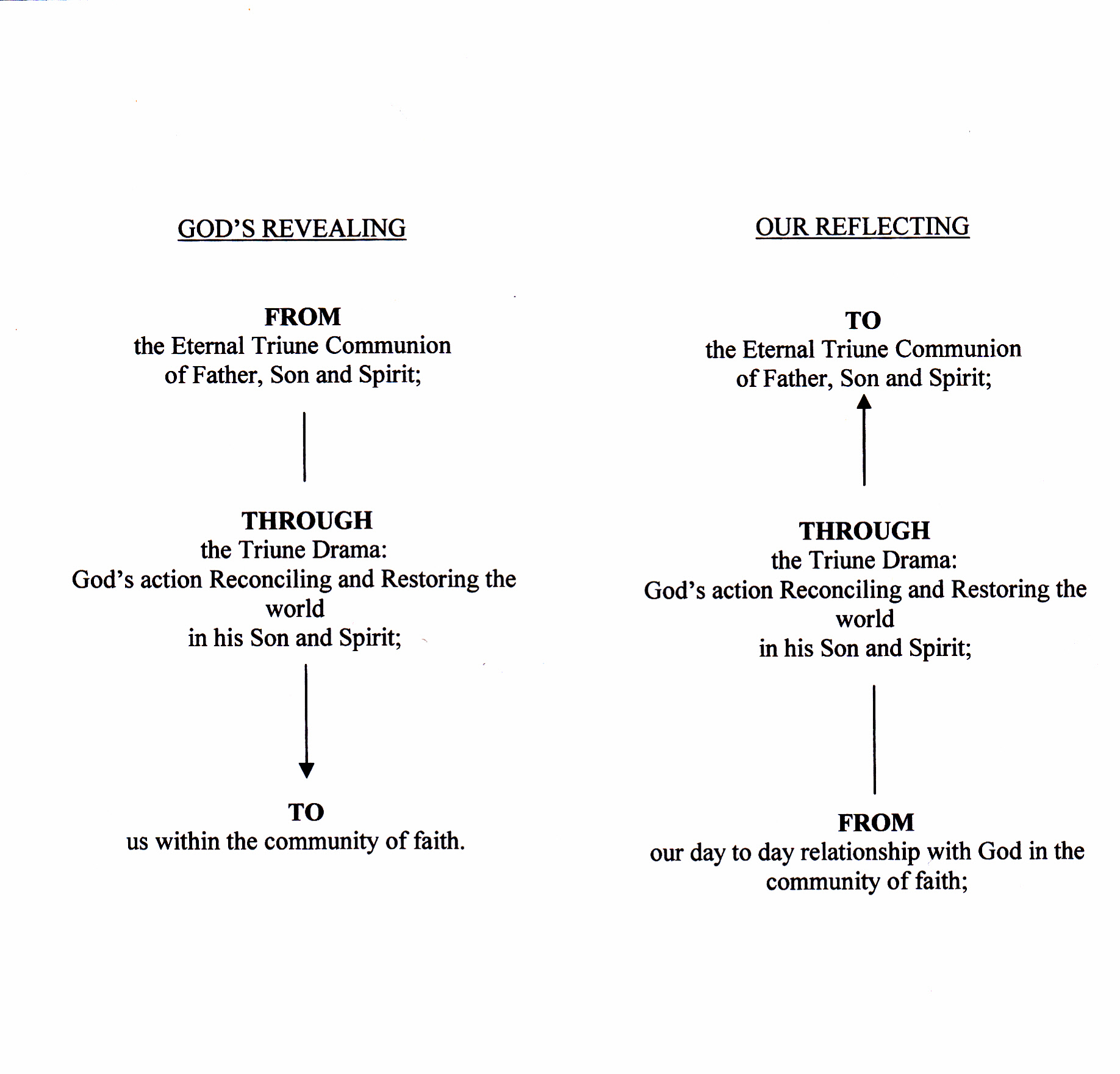
How then do we develop a Trinitarian mind so that we emerging out of our Trinitarian Faith?

I would suggest that we must continually reflect on God’s Self-Revelation.   God has revealed HIMSELF to us. So we don’t begin by projecting a concept of God as One Divine Essence and say that’s God. How do I now I make One include three. No. We begin with Who God has unveiled himself to be and we continually reflect within his self-revelation. 

Image


How then do we develop a Trinitarian mind so that we emerging out of our Trinitarian Faith?

I would suggest that we must continually reflect on God’s Self-Revelation.   God has revealed HIMSELF to us. So we don’t begin by projecting a concept of God as One Divine Essence and say that’s God. How do I now I make One include three. No. We begin with Who God has unveiled himself to be and we continually reflect within his self-revelation. 


Posted in Uncategorized | Leave a comment

Developing The Trinitarian Mind

Image

How then do we develop a Trinitarian mind so that we emerging out of our Trinitarian Faith?

I would suggest that we must continually reflect on God’s Self-Revelation.   God has revealed HIMSELF to us. So we don’t begin by projecting a concept of God as One Divine Essence and say that’s God. How do I now I make One include three. No. We begin with Who God has unveiled himself to be and we continually reflect within his self-revelation.


Let’s see how this works.


So there is a double movement in developing a Trinitarian Mind.  There is the movement of God’s Self-Revelation coming to us and there is the movement of our reflecting on his self-revelation.  As our minds are renewed in the Trinitarian way of thinking the life of Trinity within us emerges within the community of Trinitarian faith.


Posted in Uncategorized | Leave a comment

Triadic Patterns

Triadic Patterns


In Paul’s writings we see a few Triadic patterns.


1 Cor. 12.4-6    There are different kinds of gifts, but the same Spirit distributes them. There are different kinds of service, but the same Lord. There are different kinds of working, but in all of them and in everyone it is the same God at work.


Eph. 4.4-6.   There is one body and one Spirit, just as you were called to one hope when you were called; one Lord, one faith, one baptism; one God and Father of all, who is over all and through all and in all.


Gal. 4.4-6.    But when the set time had fully come, God sent his Son, born of a woman, born under the law, to redeem those under the law, that we might receive adoption to sonship.[b] Because you are his sons, God sent the Spirit of his Son into our hearts, the Spirit who calls out, “Abba,[c] Father.”


There are many more found in Paul’s writings.

One well known triadic pattern from Paul is the blessing,

Now may the grace of our Lord Jesus Christ, the love of God and the fellowship of the Holy Spirit be with you all (2 Cor. 13.13).


Posted in Uncategorized | Leave a comment

Testing

Testing the blog

Posted in Uncategorized | Leave a comment

The Circle of Love

Over the last few weeks, we have been in the upper room listening to Jesus talk about “in-ness”. I think that we can say that in the upper room we see the inner-depths of Life in the Trinity.

For the next couple of weeks, we are going to stay in the upper room to consider more of the inner depths of Life in the Trinity.  We are going to listen in on Jesus prayer to the Father in John 17.  In this prayer, we will hear Jesus talking to his Father about “The Circle of Love”.  God is Love and in his son he draws us into a circle of love.

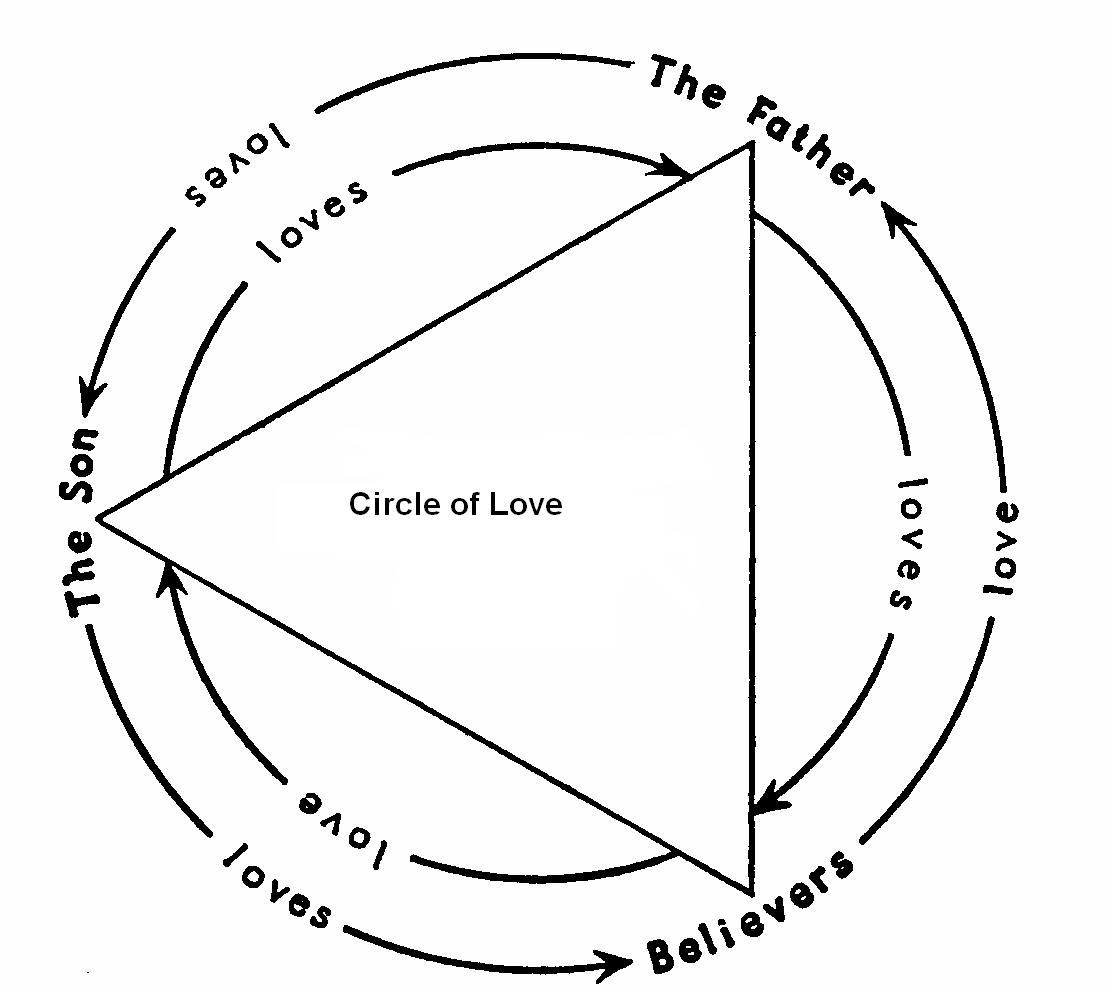
To see something of this circle of love we will follow a diagram.  The circle of love moves in two directions.

We will begin with the outer circle moving anticlockwise.

The Father loves the Son.

24Father, I desire that those also, whom you have given me, may be with me where I am, to see my glory, which you have given me because you loved me before the foundation of the world v24.

The Father loved the Son before the world was made.  If God were just a solitary being there would have been no one to love then and so God could never have been love.  But before God made anything, Father and Son were face to face and the Father was full of love for his own Son.  He was fully satisfied in his love for the Son.

He didn’t have to make someone else to love because he was longing for love.  He did not have to create, but he chose to do so freely out of his own love.

26I made your name known to them, and I will make it known, so that the love with which you have loved me may be in them, and I in them v26..’

The Father has always loved his own Son and now he has put the love he has for his Son inside those who are united to his Son.  They know within themselves the reality of the Father’s love for his son because it lives inside them as sons in union with the Son.

The Son loves Believers.

The prayer doesn’t actually say that the Son loves those who believe in him.  However, if we define love as self-giving we see the Son loving those who believe expressed in his self-giving towards them.  The Son speaks to the Father about how those who believe have been given him by the Father.  He goes on to speak about how he gives eternal life to those who have been given to them.  Then he goes on to speak in many ways of his own self-giving towards those given to him.  He gives himself to them to guard them…v12.  He gives himself to them to make the Father known to them…6, 26.  He gives himself to them by consecrating himself so that they may be set apart to God…v19.  And he also gives to us the same glory that the Father has given him.  He tells the Father about all this self-giving as he gives himself fully on our behalf in prayer to the Father.  The Son loves believers within the circle of love.

Believers love the Father.

Again, the prayer does not actually say believers love the Father.  But we hear Jesus say,

6 ‘I have made your name known to those whom you gave me from the world. They were yours, and you gave them to me, and they have kept your word…v6.

Obeying the Father is the way that we show our love for the Father.

10If you keep my commandments, you will abide in my love, just as I have kept my Father’s commandments and abide in his love (John 15.10).

Notice that we love the Father as he is revealed to us by the Son.  We have no knowledge of the Father other than what we see in the Face of Jesus.  He is the Father’s Son and so he is the Face of the Father.  As we look at the Son we see the Father as the one who has always loved us, as the one that we always belonged to and as the one who gave us to Jesus.  We come to love this Father and show our love by obeying his commands as we abide in his love.

Now we move around the inner circle clockwise.

The Father loves believers.

23I in them and you in me, that they may become completely one, so that the world may know that you have sent me and have loved them even as you have loved me v23.

How much does the Father love us?  Jesus gives us a measure.  The Father loves us even as he loves his own Son.  There is no other measure.  We cannot say well I will try to imagine how much the Father loves me.

I think he loves me so much.  We don’t invent our own measure. Jesus tells us clearly so that we don’t have to guess.  Jesus tells us The Father loves you even as he loves me the beloved Son. cf 16.27.

Believers love the Son.

Again, the prayer does not actually say that we as believers love Jesus. But in verse 8 we hear Jesus say

7Now they know that everything you have given me is from you; 8for the words that you gave to me I have given to them, and they have received them and know in truth that I came from you; and they have believed that you sent me.

.We know from what we Jesus says in other places that this is one of the ways that we show we love him.

27for the Father himself loves you, because you have loved me and have believed that I came from God (16.27).

The Son loves his Father.

In this prayer, we see many ways that the Son showed his love for the Father.

Listen to what he says in v4.

4I glorified you on earth by finishing the work that you gave me to do.

The whole prayer is a pouring out of the Son’s love for his Father just as his whole life is a love offering towards his Father.

This is the circle of love that we are drawn into.  As we look at this circle of love there are two big things that we must highlight.

Within the circle of love, we are co-loved with Father and Son.

Within the circle of love, we are co-lovers with Father and Son

Within the circle of love, we are co-loved with Father and Son.

Notice that I did not say within the circle of love we are loved by Father and Son.  I said more than that.  We are co-loved with Father and Son.  The Father loves the Son and loves us with his Son just as he loves his Son.  The Son loves his Father and loves us with the Father just as he loves his Father.  We do not separate their love for us from their love for one another.  We don’t say they love one another in a unique way and then love us differently.  We are co-loved with them.

This means we are to live loved within the circle of love.  But do we?  We see the truth that we are co-loved with Father and Son.  We could not be more loved.  We are loved as the Father loves the Son and the Son loves the Father.  And yet we do live less loved than we are.

This is not a small matter.  Nothing is more vital than living loved.  If we live less loved than we are we will short circuit our whole experience of being loved and loving within the circle of love. And that is just what we do.  We go around living less loves than we are. We need to see, really see, that we are co-loved with Father and Son so that we could not be more loved.

But how can we?  We hear this truth so much.  We know in some way that we are fully loved and yet still we live less loved.  How can we know this so that we live this?

The answer is found in who is missing from the circle in our diagram, The Spirit.  Why is he missing?  He doesn’t want to be seen.  The Spirit shows his love by becoming anonymous to serve the circle of love.  He doesn’t appear in the circle, but he is there making the circle of love real to us.  You might say that as we look at the circle of love the Spirit is nowhere and everywhere.  He is nowhere in the circle of love because he wants to remain hidden and anonymous.  He is everywhere because he is the one who serves the circle of love enabling the circle of love to be real for us. The flow of love from Father and Son to us becomes a living reality in the Spirit.  The flow of love from us to Father and Son becomes a living reality in the Spirit.

In the upper room, Jesus speaks of “The Spirit of Truth”.  He is the Spirit of truth because he makes truth known to us.  But what is the truth that the Spirit of truth makes known to us?  Is it doctrinal truth?  Is it propositional truth?  Many hear Jesus words, You will know the truth and the truth will set you free” and then stress the need to study the truth of the word in order to be free.  But is that what Jesus meant by the truth?

Jesus said, I am the way and the truth and the life.  Jesus is himself the truth.  So truth is a person.  If you know Jesus, you know the truth.  Furthermore, if you see the Son you also see the Father.  So the truth is Son and Father.  When we see Father and Son they are always in love relationship.  They are always full of delight in one another and serving one another in love.  The truth is the self-giving love of Father and Son in love relationship.  It is the dynamic reality of the life and love that is shared between Father and Son.  Not propositional truth.  The living reality of love relationship between Father and Son. When we see Father and Son in love relationship, we also see the circle of love in which we participate.  That is the truth, the circle of love.

The Spirit of truth makes known the truth to us.  He makes it known to us in such a way that it all becomes real to us.   We cannot see it ourselves.  We cannot grasp it ourselves.  We cannot enter into the reality of it ourselves.  Knowing the truth of our participation within the circle of love must be revealed to us by the Spirit so that it becomes living reality to us.  Then we know that we are loved.  We know because we know and we know because we know.  We have not worked it all out ourselves.  It has simply been given to us as truth by the Spirit of truth.  Then you experience it in a personal way.  It is not just data.  You know yourself within the circle of love fully loved by God. And it is all real. You are loved and you know it.  You know it in the Spirit within the circle of love.  You don’t try to force this.  You simply see the circle of love and let the truth of it all be what it wants to be in the Spirit.

Posted in The Circle of Love | Leave a comment

You in me

The Incarnate Son is in the Father.  He lives inside the Father.  That means there is now a real human being within the Triune Communion.  The Divine Son has always been part of the Triune Communion. But in the Incarnation the Divine Son became what he was not before, a real human being.  Now he is within the Triune Communion as a human being.

We are in the incarnate Son.  The Spirit has engrafted us into the Son so that we live inside him.  That means that we too are now part of the Triune Communion.  We don’t just look at the Triune Communion from a distance we participate in the Communion.  We share in the Son’s relationship with the Father.  He is in the Father and we are in the Father in union with the Son.

That means Belong.  We belong within the Triune Communion.  The Triune communion now includes a real human being and we are in that human being.  That means we belong.  And in that belonging we know who we are.  Or is it not better to say that in this belonging we find who we are by knowing Whose we are.  In union with the Son we belong  in the Triune Communion.

Because we belong, the Son is now preparing a dwelling place for us in his Father’s house.

2In my Father’s house there are many dwelling-places. If it were not so, would I have told you that I go to prepare a place for you?* 3And if I go and prepare a place for you, I will come again and will take you to myself, so that where I am, there you may be also 14.2-3.

The Son is now in the Father’s house or dwelling place.  He is there preparing a place for us so that we can be with him where he is.  More than anything else, he wants us to be with him where he is.  He wants us to be in his home.  His home is in the Father.  He lives inside the Father.  He always dwells within the deep love of his Father.  And he always wants to open his home to us so that we can be home with him in the Father.  That is where we will be forever.

Not only are we in the Son, he is also in us.  We live inside him.  He lives inside us.  He is in us by the Spirit.

These words about Jesus being in us come immediately after a promise of the Spirit.

In v16-17 Jesus promises,

I will ask the Father, and he will give you another Advocate,* to be with you for ever. 17This is the Spirit of truth, whom the world cannot receive, because it neither sees him nor knows him. You know him, because he abides with you, and he will be in you.

Jesus says to his friends he (The Spirit) abides with you, and he will be in you.   Then Jesus says immediately,

“I will not leave you as orphans I will come to you.  The Spirit in them means Jesus coming to them.  He will not leave them bereft in the world as orphans; he will come personally to them through the indwelling Spirit. the next but one statement is the one we are looking , “I in you”.

We have already seen in the weeks past that the three persons live inside one another.  That means where the one is the others are too.  So, the Spirit indwelling us is the Son indwelling us.  The Son lives inside the Spirit and the Spirit lives inside the Son.  Where the Spirit is the Son is.  You cannot separate them.  You cannot have one without the other.  The Spirit is the reality of the Son in us.  The Son is not somewhere up there in his Father.  He is not separated from us in the far corners of the universe.  The Son is now within us expressing himself in our humanity.

If the Son is in us by the Spirit so is the Father.  Because of this, Jesus goes on to tell us that he and the Father have come to make their home with us.

‘Those who love me will keep my word, and my Father will love them, and we will come to them and make our home with them. v23

The Spirit indwells us and by his indwelling the Father and Son indwell us.  That means we become the home of Father and Son in the Spirit.  Our sharing in the Triune communion could not be deeper.  They don’t simply include us in their communion they come and make their home in our hearts.  They come to abide with us as their permanent dwelling place.  All three persons live inside one another in a communion of love.  The Son is in the Father.  The Father is in the Son.  The Spirit is in both Father and Son.  And so, through the Spirit’s indwelling, both Son and Father make their home inside us.

Father and Son have made their home with us and we find our home in them.  Within this home, we share in the Son’s love, joy and peace.

As Father and Son make their home with us, we share in the Father’s love for his Son. In his prayer in John 17 Jesus speaks much about the Father’s love for the Son.  The Father has loved the son before the foundation of the world and his love for his Son is full and overflowing.  Towards the end of his prayer the Son says to his Father I want the love with which you have loved me to be in them and I in them.

26I made your name known to them, and I will make it known, so that the love with which you have loved me may be in them, and I in them.’ John 17.26.

Note what he wants,

“the love with which you have loved me may be in them, and I in them.’ .

As Father and Son make their home with us, we share in the Son’s joy

13But now I am coming to you, and I speak these things in the world so that they may have my joy made complete in themselves 17.13.

Notice that Jesus speaks about my joy in them.  In love relationship with the Father, the Son has great joy.

It is the joy of the Father’s home.To be at home with the Father in love relationship is to be full of joy in the Father’s love.A joy that surpasses all other joys.  As Father and Son make their home with us, we enter into the joy of their home. The joy that The Son has in love relationship with his Father is in us as he is in us.

As Father and Son make their home with us, we share in his peace.  Home is supposed to be a place of peace.

While outside the home all may be broken and chaotic, within the home there is perfect shalom.  In many human homes, this peace is not enjoyed, but in the Father and Son’s home there is perfect peace.  As they make their home with us we experience this peace that surpasses all understanding.

Jesus speaks of this in 14.27

27Peace I leave with you; my peace I give to you. I do not give to you as the world gives. Do not let your hearts be troubled, and do not let them be afraid.

Note he says my peace, not just peace, but my peace.  The peace that I have at home with my Father in you.

The Son enjoys love, joy and peace at home within his own relationship with his Father.  And as he and his Father make their home with us  we know his love, his joy and his peace.  We share in his love relationship with the Father because we are in him and he is in us.  He is our home and we are his home.

All this anticipates the final consummation of our experience of God.  As the vision of the New heaven and new earth opens up a loud voice from the throne says,

3And I heard a loud voice from the throne saying,
‘See, the home of God is among mortals.
He will dwell with them;
they will be his peoples,
and God himself will be with them;
4he will wipe every tear from their eyes (Revelation 21.3-4).

That is the hope before us, God making his home among us in the new earth. Meanwhile the same Triune God makes his home with us. And as they make their home with us we find our home in them.

What does this mean for us in our daily living?

Last time we saw that it means Belonging.  And within that belonging we find who we are by knowing Whose we are.  When we hear that in the Spirit, Father and Son have made their home with us we see our belonging even more fully.  We belong in them so fully that Jesus prepares a home for us with the Father.  Furthermore, we belong in them so fully that they have made their home with us.  We really do see now Whose we are.  We belong to Father and Son and they belong to us.They make their home with us and we find our home in them.

We also saw that belonging means Becoming. We belong to the Triune Communion and now we are called to Become who we are by living out our personal communion.  As we hear Jesus say he is in us and through his indwelling, he and the Father have made their home with us we see that becoming is not down to you and I with all our individual effort.

Too often, we attempt to live as individuals trying to make it with an individual God up there.  You are standing on your own as an individual.  You are left to get to know God better by your own efforts.  You are left to relate to God and to reflect God in the world by your own individual disciplines.   You are left thinking that any good thing arising within you comes from yourself and must be nurtured by yourself.    All this becomes very debilitating as you live under the illusion that you must produce all things in and of yourself under your own steam.  You stand on your own before the solitary God who frowns on you in disappointment over your ongoing poor performance.

We must rather see that that the Son is in us.  And he is in us to live out his own love relationship with his Father in and through us.  He is living out his relationship with his Father within us.

What is our part?  We simply respond to his activity within us.  As we do so, we become who we really are, those who belong to the Triune Communion and who are now becoming who they are in daily experience.

Jesus wants us to see that we are all in one another.  The Son is in the Father.  We are in the Son.  The Son is in us, which also means that both he and the Father are making their home with us.  This also means that we are in one another as God’s community.

Listen to Jesus speaking to his Father,

20 ‘I ask not only on behalf of these, but also on behalf of those who will believe in me through their word, 21that they may all be one. As you, Father, are in me and I am in you, may they also be in us,* so that the world may believe that you have sent me. 22The glory that you have given me I have given them, so that they may be one, as we are one,23I in them and you in me, that they may become completely one, so that the world may know that you have sent me and have loved them even as you have loved me (John 17.20-23).

We are all in one another.

Posted in Oneness, Uncategorized | 1 Comment

I in You

The Son was always in the Father.  He was always God living inside the Father

Then the Son became human.  He did not just appear as a human he became fully human as one of us.  Here, in John 14.20, he is speaking to us as the incarnate Son.  He is telling us that he is still in the Father as a human being.  This Son of the Father has become human forever.  Now at the centre of heaven, we find a human and this human is in the Father.  So the Triune communion now includes a human being!  Before the incarnation of the Son, there was Father Son and Spirit.  Now there is Father, Spirit and Incarnate Son.

The human being who is now part of the Triune Communion is a real human.  He is fully human as we are.  The Son did not just appear as a human.  He became a real flesh and blood human as we are.  Nevertheless, we must be clear that he is now a new human.  The Son came into our real humanity.  He took it down into death to bear the consequences of human sin and then he rose again as the new man who is head of the new humanity.  Following his resurrection, he was taken into heaven to be in the Father as the new human, the new humanity, the new creation.  The human being who is now part of the Triune Community is the new human who is real human as we are.

This is amazing in itself, but Jesus goes on to amaze us even more by saying, “and you in me”. Triune communion now includes a human being and we are in this human being.

What does this say about our relationship to the Triune communion?

The Son is in the Father.  That means he lives inside the Father.  Jesus says we live inside him in the same way.  That means we are included in the Triune Communion.

The triune communion now includes a human being and it also includes us.  We are fully included in the communion.

Does that mean we become divine?  The early church fathers used to say that the Son become human so that we might become divine. Is that so?  We do not become divine in the sense that we now share in the divine being.  Nevertheless, we do share in the Son’s life in God.  In union with the Son, we share fully in his own unique life in his Father.

That means we share in his continuing love relationship with the Father.  The Son is fully loved by his Father. On earth he heard the Father say, you are my son whom I love with you I am well pleased.  The Son continues to live loved by Father.  In union with the Son, that which is his becomes ours.  He is loved fully; we are loved fully. If I say, God does not really love me then I am saying God does not really love his Son.  I am in the Son.  Everything that is true of him is also true of me. He is the Father’s beloved Son and I am the Father’s beloved son in union with him.   Here lies the deepest truth about us.

Baxter Kruger says,

Staggering and startling as it is, it remains the great truth about us.  It is the secret of our existence. It may be veiled to us, hidden from our sight and very far removed from the way we see ourselves and our lives; nevertheless, it is true. The eternal Son became human. As a human being, he knows his Father inside and out, and dwells in faithfulness and security, joy and freedom with his Father in the Spirit. And we have been included in his incarnate relationship with his Father. We are included.

What does all this mean to us in our daily living?

I want to look answer that question by considering Belonging and Becoming.

Belonging

One of the most important things in human life is Belonging. We really find our true identity in knowing we belong.  This is not so strong in our individualistic culture.  Each individual seeks to find his or her identity in  what I acquire or what I achieve.  But this individual identity is always lacking and the human heart cries out for belonging.  Who we are and what our lives mean is found in belonging to someone or something.  Identity is communal and relational.

Jesus tells us that we belong to the Triune Communion.  The Triune communion now includes a real human being and we are in that human being.  That means we belong.  And in that belonging we know who we are.  Or is it not better to say that in this belonging we find who we are by knowing Whose we are.  In union with the Son we belong  in the Triune Communion.

Our belonging is Sure. It is sure because we belong in union with the incarnate Son.  Our belonging does not depend on us or anyone else.  It simply depends on union with the Son.  He belongs as a new human being within the Triune Communion and we belong in union with him.

Our belonging us Real. This is not an imaginary belonging.  We don’t just say it is a great idea to lift us up, but it is not real.  Our union with the Son is real.  The Son united himself with us in our humanity and remains united with us in our humanity as the new man.  And the Spirit, through faith, unites us to him.  The Spirit brings us to faith in Christ by revealing Christ to us.  Then, having brought us to faith, the same Spirit engrafts us into Christ.  Being in Christ is not just an idea it is a reality through the Spirit.

You can sense something of how real it is when you hear Paul’s words to the Colossians,

So if you have been raised with Christ, seek the things that are above, where Christ is, seated at the right hand of God. 2Set your minds on things that are above, not on things that are on earth, 3for you have died, and your life is hidden with Christ in God. 4When Christ who is your* life is revealed, then you also will be revealed with him in glory (Colossians…3.1ff).

Becoming

We already belong to the Triune Communion.  We are now called to become who we are in our daily experience.  We are to become Son’s and daughters who actually live in the communion that is already ours.

It is very important that we see our call to actual communion in terms of belonging followed by becoming.  If we fail to see that we already belong in the Son’s relationship with the Father we will be left ever striving for our own union with God.

We will always be on the performance treadmill trying to move towards union with God by doing our best to appease him and by doing our best to use techniques to gain union with God.  We will always fail in this pursuit and so we will never be at rest in God. We must see that we already belong. We cannot be more in union with the Father than we already are.  And within the joy of this belonging we seek to become who we already are in our daily experience.

Evangelicals are fond of talking about each person’s own relationship with God.

I am then expected to pay a lot of attention to pursuing my own personal relationship with God  But should we talk about my personal relationship with God?  Should we not rather talk about Jesus’ relationship with his Father and my participation in that relationship as the main thing?You are not a lone ranger, striving for your own relationship with the Father.  You are always included in Jesus’ relationship with the Father.  John’s gospel is the stunning news that the Father’s Son has received us into his relationship with the Father.  Jesus has included us in his life with his Father in the Holy Spirit. So it might not be right for us to talk about our relationship with God.  What John points us to his something better – we get to share in the Son’s relationship with his Father.  The Fathers’ Son has become human to lift us up into himself and his relationship with his Father.

We aim to become who we already are in our daily experience.  But we do not do this alone.  Jesus says, you in me, and I in you.  The Son is in us by the Spirit to enable us to become who we are in our daily experience.  We will explore that next time.

Posted in Oneness | 1 Comment

I am in my Father

The purpose of the Triune communion is inclusion.  The three want to include us in their communion of love.  More specifically, we saw that the purpose of the Triune Communion is to adopt us into the Son’s relationship with the Father so that we share in their fellowship.  We can now say with John, “Our fellowship is with the Father and with his Son…

In this post, I want to look at this same purpose of inclusion as we hear of it from the mouth of Jesus himself in John 14:20.

I am in my Father

and

you  in me

and

I in you.

Jesus tells us that we are all In One another.

I am in my Father

It’s odd for us to talk about being “in” another person.  We usually talk about togetherness as being “with” someone else.  Why does Jesus say he is “in” the Father?

I think that ultimately, we will have to admit that we don’t really know what “in” means.  Jesus is taking us into depths that leave us out of our depth.  The best place to begin is to say we don’t really know what is going on.Nevertheless, we can look at Jesus in the Father in three ways.

Father and Son are One in Doing

Earlier in this passage, we hear one of Jesus disciples say, “Lord show us the Father”.  Jesus replies whoever has seen me has seen the Father.  Then he elaborates with these words,

10Do you not believe that I am in the Father and the Father is in me? The words that I say to you I do not speak on my own; but the Father who dwells in me does his works.11Believe me that I am in the Father and the Father is in me; but if you do not, then believe me because of the works themselves.

14.10-11

The works that Jesus is doing are the works of the Father.  Whatever Jesus does the Father is doing because the Son and Father are in each other.  You cannot separate them.  When the Son works to help people the Father is working in him.  They are in one another.  So Jesus can say if you have seen me you have seen the Father.

All through the gospel of John you see Father and Son in one another in doing.  Right at the start John speaks about God creating all things through the Son.  We go on and see the Son always looking towards the Father to see what he is doing and moving with the Father into healing people and teaching people and liberating people.  He always listens to the Father and responds to what he says and does. Jesus moves towards his death on the cross only at the time that set by the Father.  He must offer himself to the Father on our behalf in the Father’s time because he does all in union with the Father.  You cannot separate Father and Son they always live and move and act together.  They always have and they always will.  The Son is always in the Father.

Father and Son are One in Loving

God is love. And in Jesus prayer to the Father, recording in John 17, Jesus speaks about in-ness as oneness in love.  The Father loves the Son giving himself entirely to the Son.  The Son loves the Father giving himself entirely to the Father.  Between Father and Son there is a continual movement of self-giving that is total.  And the Son’s self-giving love towards the Father is so deep that it can only be described as being in the Father. There is no separation, no distance or withholding.  Rather there is full freedom to know and be known, unqualified appreciation and unreserved embracing,  complete sharing and self-giving.

All through John’s gospel we see Jesus indwelling the Father in love relationship.  Every step he took was with the Father in love.  All through we see the main thing is the Son’s love relationship with his Father.

Father and Son are One in Being

Before the Son became human, he was in the Father so that they were One in Being. John opens his gospel by telling us that the Son was with God and was God.  As a human, we hear Jesus take the Divine name “I Am” to himself.  And towards the end of John’s gospel Thomas falls before him saying, “My Lord and My God”.  In this broader context when Jesus says, “The Father and I are One” he means more than one in will and purpose. Father and Son are One in Being.

We saw previously that the church came to speak about this mutual indwelling as “perichoresis”.  The word has the idea of one thing containing another.  The Son contains the Father.  The Father contains the Son.  Both Father and Son contain one another in the unity of the Spirit.  The Father contains the Son in himself so that they live inside one another.  Yet the Son remains the Son distinct from Father and Spirit.

This perichoretic unity shared by the divine persons goes beyond any kind of unity found within creation. It is deeper than anything experienced between the closest human persons.  We cannot grasp this.  It is the mystery of the Trinity.

The Son was always in the Father.  Then the Son became human.  He did not just appear as a human he became fully human as one of us.  Here, in John 14.20, he is speaking to us as the incarnate Son.  He is telling us that he is in the Father as a human being.

This Son of the Father has become human forever.  He didn’t unzip his human skin when he returned to the Father, he remained fully human.  Now at the centre of heaven, we find a human and this human is in the Father, he mutually indwells the Father.  He is in the Father and the Father is in him.

Do Father and Son still live inside one another as fully as they did before the Son became human?

The incarnate Son is still in the Father.  He is still one in Being with the Father.  They still live inside one another and always will even though the Son remains fully human forever.

We don’t really know what is going on when Jesus says that he is in the Father as a human being.  He is taking us into depths that leave us out of our depth.  Nevertheless, we must see that he is telling us something that is truly amazing.

He is telling us that 

the Triune Communion now includes a human being!

Why would the Son of God become human?  He had no need of this.  He has forever known his Father and enjoyed his Father’s full attention and affection.  He has forever shared in the fellowship of life with his Father in the Spirit.    Why would he become human?  Was it because of some deficiency in his fellowship with the Father?  Was it because of boredom?  The only reason to become human was to include us in the Triune Communion. We will explore this as we consider the next statement,

“You in me”.

Triune communion now includes a human being and we are in this human being.

What does this say about our relationship to the Triune communion?

Posted in Oneness | Leave a comment

One Purpose in Communion

Within the communion of three persons, there is a single purpose.  This single purpose is born out of the self-giving love of the three.  And the three persons are always together in achieving this single purpose.

What is this One purpose shared by the three?  We can state this purpose in a few sentences.

The purpose is to extend the communion of love to include us.  The three say this communion of love is too good to keep to ourselves we want to open it up to include others.  The one purpose of Triune communion is inclusion. The three want to draw us within the circle of their shared life and love.

We can also say what the single purpose is in a word-Adoption.  The purpose of Triune Communion is to adopt us into the Son’s love relationship with the Father in the Spirit.  We sometimes speak about receiving Christ into our lives.  But God’s purpose is that the Father’s Son might receive us into his life.  In his life, we are adopted sons and daughters sharing in his love relationship with the Father.

We can look at the One purpose in communion as adoption before time, within time and beyond time.

The Purpose of Adoption BEFORE TIME

Paul tells us that before the world was made,

“In love God destined us for adoption as sons through Jesus Christ, according to the purpose of his will… (Ephesians1.5)

Before time, God destined us to adoption.He destined us to adoption in love.  He destined us to adoption in his son.   He did this so that as adopted sons and daughters we would share in his love relationship with the Beloved Son.

If we want to understand who we are and why we are here, then we must begin with the communion of the Father and Son in the Spirit.  This relationship holds the answer to the “why” of creation, the “why” of your life and mine.  When we start with the Triune communion the purpose of creation emerges.  The Father, Son and Spirit created the human race to share what they have together with us.  They brought us into existence so that we might share in the Son’ love relationship with the Father in the Spirit.   The One purpose arising out of the triune communion, before time, is our adoption into the Son’s relationship with the Father.

The purpose of Adoption WITHIN TIME

God’s purpose before time was that we might be adopted in to the Son’s relationship with the Father so that we might participate in the triune communion.  But humanity chose to reject this and go the way of independence.  We wanted to live our own way apart from God.  But the Triune communion did not give up on their purpose.  Together they said we love them so much that we refuse to exist without them.  We will go after them and bring them back into the communion.

According to Galatians 4.4-6, The Triune God moved into action the in “The fullness of time” or “When the time was fully come”.  At this time God moved in two ways.

God sent his Son (v4, 5)

4 But when the fullness of time had come, God sent forth his Son, born of woman, born under the law, 5 to redeem those who were under the law, so that we might receive adoption as sons.

The Father and Son enjoy love relationship with one another.  Out of this love relationship, the Father sent the Son to become human.  He sent him with the purpose that we might be adopted as sons (the term sons includes daughters).

Seeing the incarnation this way has great meaning for us.  Irenaeus, of the church Father’s, used to say,  He became what we are that we might become what he is.  He became what we are- human.  That we might become what he is-sons.  He is the Father’s Son, the unique son.  We become what he is, son’s and daughters of the Father.  We become sons and daughters because of our union with The Son

In what sense are we now sons in union with the Son?

Some point to our legal status.  Adopted sons have a legal status.  So we have the full legal rights to be sons and daughters of God.  The NIV highlights this in the way it translates Galatians 4:4

4 But when the time had fully come, God sent his Son, born of a woman, born under law, 5 to redeem those under law, that we might receive the full rights of sons.

The western side of the church has always stressed the legal aspects of salvation.  That’s why so much is said about the need for a change in status.  We major on justification by faith as right status before God.  Adoption follows this right status as the full legal rights of adopted sons.

We must ask two questions at this point?

Is it true that adoption refers to our legal status as Sons and daughters of God?

Yes.

Is our adoption as sons and daughters more than legal status?

Yes.

The full truth is God’s Son became what we are so that we might become what he is.  He is the Son of God in love relationship with the Father.  He doesn’t just have a legal status as son, he is in love relationship with his Father.  We are now in union with the Son so that we become what he is.  We share in his love relationship with the Father.

But in church as we have known it, has this relational side been under emphasised and the legal side over emphasised?

God sent his Spirit v6

6 And because you are sons, God has sent the Spirit of his Son into our hearts, crying, “Abba! Father!”

Note that the Spirit is identified here as the Spirit of God’s Son. The Son was sent into the world to make us sons.  Now the Spirit of that same Son is sent into our hearts.

The Spirit of God’s Son cries Abba Father within us.  Abba is the Aramaic word for Father. It means something like Papa.  While God’s Son was on earth, he addressed God as abba.  In the garden we hear him pray,

‘Abba, Father, for you all things are possible; remove this cup from me; yet, not what I want, but what you want’ (Mark 14:36).

The Spirit of God’s Son now cries the same abba within our hearts.

As the Spirit cries abba within us are we mere spectators of the Son’s love relationship with abba?We may observe this love relationship as mere spectators.  We ponder passages of scripture.  We read books to help us ponder better.  We stand back and see the sheer beauty of this love relationship between Father and Son.  It may be moving to do so.  Yet we are mere spectators.

Father and Son want us to move from spectators to participators. They want to include us.  They don’t want to keep the love relationship to themselves.  They want to open the circle and bring us in so that we actually participate in the love relationship.

The Spirit of God’s Son is the one who enables us to participate.  Through the Spirit of God’s Son within us, the son’s own abba before the Father cries out within us as we share in the Son’s relationship with abba.In heaven, Jesus speaks his own abba before the Father and his abba is echoed in us through the Spirit of the Son within us.  This is sharing in the Son’s abba relationship in the Spirit.

Because of our individualist mindset, you may view this participation as an individual in isolation. The Spirit cries abba within my heart.  And so I, as an individual, participate in the Son’s love relationship with the Father.

But Paul is speaking here about participating communally in the Son’s love relationship with the Father.  All the pronouns are plural.

This is the Purpose of adoption within time. It is the purpose that flows from the heart of the Triune Communion

The Purpose of Adoption BEYOND TIME Roman 8.18-23

18 For I consider that the sufferings of this present time are not worth comparing with the glory that is to be revealed to us. 19 For the creation waits with eager longing for the revealing of the sons of God. 20 For the creation was subjected to futility, not willingly, but because of him who subjected it, in hope 21 that the creation itself will be set free from its bondage to corruption and obtain the freedom of the glory of the children of God. 22 For we know that the whole creation has been groaning together in the pains of childbirth until now. 23 And not only the creation, but we ourselves, who have the firstfruits of the Spirit, groan inwardly as we wait eagerly for adoption as sons, the redemption of our bodies.

In this passage, Paul personifies Creation .  It is like a person longing for something big in the future.  What is creation eagerly longing for?  It waits with eager longing for the revealing of the sons of God.  In God’s new world to come the sons of God will be revealed in full freedom and glory.  Then the creation itself will be set free from its bondage to corruption and obtain the freedom of the glory of the children of God.

For all this, the creation groans with longing.

Paul goes on to say,

And not only the creation, but we ourselves, who have the firstfruits of the Spirit,  groan inwardly as  we wait eagerly for adoption as sons”.

In these words we hear the tension of the already and not yet.  God’s Sons and daughters already have the firstfruits of the Spirit.  We already have the Spirit as the Spirit of God’s Son, the Spirit of adoption.  In the Spirit, we enjoy the already of our adoption.  Paul speaks of this earlier in the passage

15 For you did not receive the spirit of slavery to fall back into fear, but you have received the Spirit of adoption as sons, by whom we cry, “Abba! Father!”
16 The Spirit himself bears witness with our spirit that we are children of God, Romans 8:15-16

Nevertheless, the fullness of our adoption is not yet.  And so we groan within us as we wait for the fullness of our adoption.

  • In that fullness, our bodies will be resurrected so that we share the resurrection body of God’s Incarnate Son.
  • In that fullness, we will enjoy the freedom and glory of the sons and daughters of God.
  • In that fullness, we will participate fully in the Triune Communion.

In, freedom, and glory we will share in the Son’s relationship with the Father in the Spirit.  This is the finale of the One purpose of Triune communion.

Posted in Triune Community | Leave a comment